/ JOURNAL
Fastmail and Google, not Fastmail or Google
If you’ve ever thought about moving away from using Gmail and Google Calendar, I want to outline some ways Fastmail helps you do that, either migrating entirely or partially.
One of Fastmail’s finest qualities, I think, is not judging your relationship with Google. There are other qualities.
In my case, I have a Google address that I know I’ll need for a long time to come for shared calendars, Google Docs, YouTube and Google Home services. That account isn’t going anywhere, however I feel about Google as a company.
Fastmail will help you move migrate away from Google wholesale if that’s what you want to do, but it’ll also let you maintain an arms-length ongoing relationship with that Google account.
Fastmail lets you connect your Google calendars and manage them from Fastmail or whatever calendar app you choose. It’ll check your Gmail inbox for you and import your mail, in bulk and on an on-going basis. It’ll let you send from Gmail directly from Fastmail or whatever email client you choose.
Here’s what my own setup looks like:
- My primary email accounts are on Fastmail using my own domain names
- Whether its my iPhone or MacBook, I mostly use Apple’s Mail.app for email, Fantastical for calendars, Cardhop for contacts or Fastmail itself in the browser but I can use whatever app I want to use
- Fastmail’s own apps are good, customisable and its search is particularly strong (i.e. ‘better than Gmail’ strong)
- My Google account is connected to Fastmail. I chose to import my entire email archive from Gmail into Fastmail, and it continues to import any new mail from Gmail as it arrives, and deletes it on Gmail. You can choose to leave a copy on Gmail instead
- I can continue to send email using my Gmail address from Fastmail anytime I want and every email I send goes into my Gmail sent folder as well as Fastmail's
- I’ve also connected to my Google account in Fastmail’s calendars, so that I can see the couple of Google calendars that I need access to (a shared family calendar) alongside my personal calendars in Fastmail
Not everyone has the choice to completely de-Google their lives. What I love about Fastmail is that it lets you define the relationship you have with Google, and it doesn’t judge you for it.
Making space
I don’t make new year’s resolutions, but I do think about things I’d like to get better at. Good habits that I want to form. And one of those is reading more fiction.
Over the last decade I've neglected fiction in favour of work-related reading and endless football-related comfort reading.
One of the things I’m learning this year is that in order to read more, I need to consciously do less of something else in order to make the space for the reading to happen. Obvious, right? But I think I tend to try and take on new habits on top all the things that I’m already doing then feeling disappointed in myself for not succeeding. A bad habit.
Inspired by Caroline Crampton’s reflections on how she read in 2024 in Reading A Lot, But Differently, I’m making space by listening to fewer podcasts; being even stricter with my daily screen time on Bluesky and Mastodon; and serendipitously being off Instagram altogether (you know why).
So far it’s working and I’m reaching for a novel because I want to pick it back up, not because I think I should. Right now that’s Paul Auster’s 4 3 2 1. Auster is long-time favourite from the pre-digital days when I was a far more confident reader. He felt the most appropriate of choices.
One positive side effect of this is that I'm listening to far more music while reading. Ambient, classical, and jazz from the period Auster's book is set in and taking real pleasure in new discoveries and the general wellbeing that I know I get from being immersed in sounds as well as words.
I’m still wrestling with favouring the convenience of ebooks over the tactile promise of print, but maybe that’s for next year.
Blog Questions Challenge
Nobody tagged me — I don’t write often enough to be ‘a blogger’ — but you know, sometimes you just have to find a reason to post.
This post was inspired by a series of my own internet favourites writing about how and why we blog. So thanks to Jon Hicks, Ethan Marcotte, Rachel Andrew and more for their own posts and their inspiration down the years. At this moment in time, in this technology culture, holding on to independent publishing feels more important than ever.
Why did you start blogging in the first place?
I’m of a generation of designers where blogging was an expectation so I started because I thought I should, but continued because I needed and wanted my own space.
In part that’s been about finding and shaping my own voice, and not wanting to be confined by corporate blogs where that’s the culture. As an introvert, the written word comes more naturally to me, and the act of writing is often how I form my own perspectives.
This site's posts date back to ~2014, but I've been writing occasionally online for a good decade before that. I've not preserved the posts from those earlier days, but maybe that's a little project for the future.
What platform are you using to manage your blog and why did you choose it? Have you blogged on other platforms before?
I’m using Kirby right now. Like so many of my peers, I’ve messed about with almost everything, but Textpattern was the first thing that had the feel of an environment that I truly enjoyed and wanted to write in.
Since then, I’ve had brief flings with Statamic, Eleventy, but Kirby is the first thing in a while that’s felt like a true Textpattern-like home. The highest of praise.
So much of a blogging CMS is about feel to me. I’ve tried but never quite clicked with Movable Type, WordPress and more. I’m drawn to the more spare and minimal environments; to flat files and Markdown. Writing shouldn’t feel hard.
How do you write your posts? For example, in a local editing tool, or in a panel/dashboard that’s part of your blog?
That I’m writing in a mix of iA Writer and Kirby’s interface is really my own fault. I initially set Kirby up from its Plainkit, and I write so infrequently these days that when I do I keep finding things I’ve not built in yet, and need to. Someday I will fix this but, once again, today is not that day.
When do you feel most inspired to write?
Only very occasionally. Like a lot of us, I share less and less online these days, and I’m resistant to adding to the middle-aged white guy noise. So, in the main it’s about scratching an itch, something that feels more than a social media length thought, or something where I’ve no outlet for it otherwise.
Do you publish immediately after writing, or do you let it simmer a bit as a draft?
I’m so prone to posting and fixing that I try and let a post ‘sit’ for while before making it public but I am my own worst sub-editor.
What’s your favourite post on your blog?
7/7 from 2020 means a lot to me. It’s a rare post for me in that it is relatively personal; very much written as an act of memory for a place and period of my life; and because the London bombings were such a shocking, defining moment.
Any future plans for your blog? Maybe a redesign, a move to another platform, or adding a new feature?
As mentioned further up, I know I’m barely scratching the surface of what I could be doing with Kirby. In my dreams I’d love to replicate the sort of automatic publishing/sycing from iA Writer to a live site that I very briefly had with Statamic. Less friction, more publishing.
Next?
Ben Terrett, Phil Gyford and Russell Davies are three of my favourite internet people, and a central part of the UK’s distinct blogging culture. I’m really interested in how Ben and Russell have, unlike me, had the discipline to resist the lure of the shiny new thing and defiantly stick with Typepad. Phil’s weekly posts are my favourite thing on the internet right now.
Honour thy error as a hidden intention
As a younger designer, I think I imagined every move in my career would be linear: a logical, progressive step from what came before to what would come next. Nice and neat. But careers, like lives, are rarely like that.
The through line of my career has been curiosity. Wanting to see both private and public sector; to work client-side and agency-side; freelance and perm; and both leading and doing. Jumping between new worlds, learning, and letting them inform my practice.
Not every role works out, and what you learn from those roles often isn't what you expected to learn. I’ve held roles that weren’t right for me, or me for them. And that, with the best of intentions on all sides, happens. But my self-critical brain is wired to see these as errors.
In ‘Eno’, Gary Hustwit's brilliant documentary film, Brian Eno talks about the origins of oblique strategies, including this one: honour thy error as a hidden intention. Using an error creatively, as a thing to build upon. It’s been on my mind lately as I’ve been thinking about the kind of work I do next.
It's through reflection that you find meaning, perspective and the hidden intention. Every role you’ve held shapes you and the learning informs and — critically — makes possible what comes next.
It concentrates the mind on the values you hold to be important in an organisation; the roles where you can give the best of yourself; and the types of work you find the greatest emotional reward in.
I'm finding that journey both more winding than I once expected, but also richer for it.
A northern cathedral
In Paul Morley's epic telling of The North (And Almost Everything In It) he writes about The Co-operative Insurance Tower, built in 1962 as Manchester's 'necessarily bold symbol of a post-cotton fightback'.
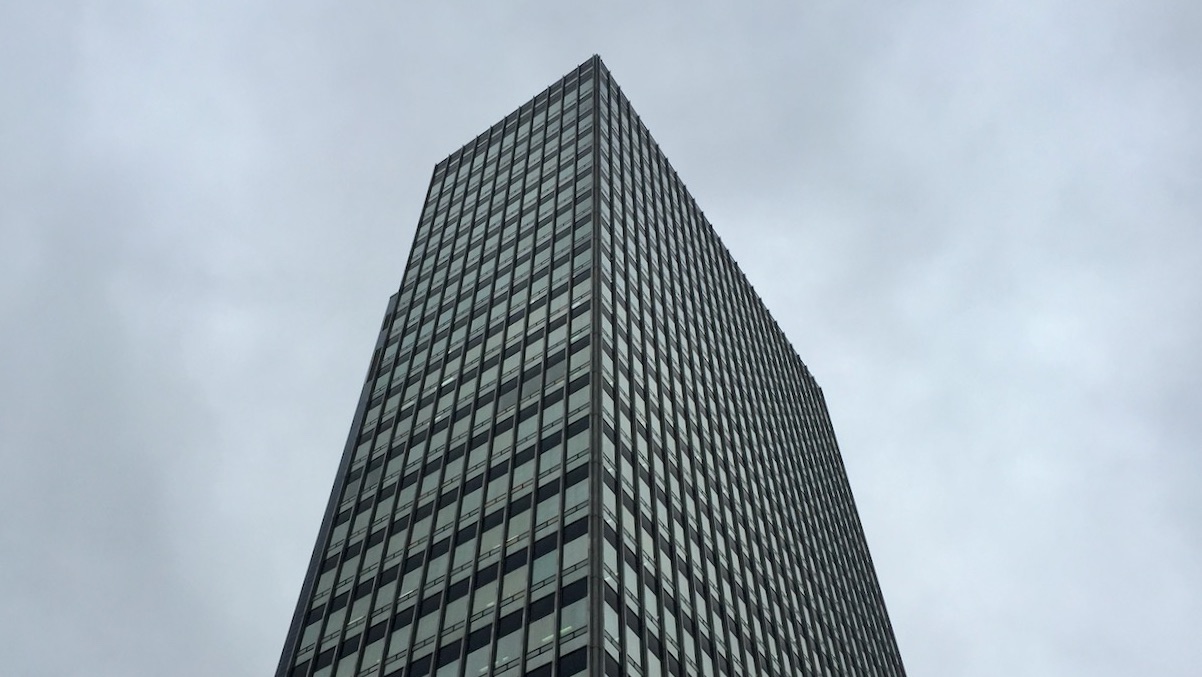
Inspired by modernist architectural thinking in the US and Chicago's 1958 Inland Steel Building in particular, the Co-op's tower both physically and symbolically represented the largest building outside of London, and the unique institution that built it, for over 40 years.
After the trauma of recent years, The Co-op is rebuilding again. Inside another revolutionary piece of architecture, directly opposite the tower, The Co-op is building an extraordinary digital team, a different type of architecture to re-imagine The Co-op's future.
I'm joining that team as head of digital design, working with a group that has no equal in Mike Bracken, Tom Loosemore, Ben Terrett, Russell Davies, Mat Wall, Jamie Arnold and more. A group of people I worked adjacent to in a government department while they were inspiring all of Government at GDS and that I am incredibly lucky to now have the chance to learn from directly.
Looking back at my time working as HMRC's head of design, the thing that ultimately gave me most satisfaction was bringing good, meaningful digital design jobs - contract and permanent - to the North East of England. As someone from even further north, who never had the chance to work as a designer in Glasgow, my home city, I feel more passionate than most about designers being able to stay in, return to and even to discover for the first time one of our greatest cities. And that's what Manchester is, a great city for design and for designers.
Morley goes on to describe the Co-operative Insurance Tower as:
‘A cathedral to egalitarianism and northern pioneering spirit, with every aspect of its design an exercise in elegance and perfection.’
That's the spirit we'll be channeling at The Co-op.
Older posts